Tutorial 8 of 9
Meteor showers and dark nights
Beginner 6 min
Find the best meteor shower of the year for your place, see how much the Moon spoils it, plan the night hour by hour and check whether any night is dark enough.
The Sky events tab (key 9) collects the events you plan a night around. Its first two buttons, Meteor showers and Dark sky tonight, answer "which night should I go out, and when?".
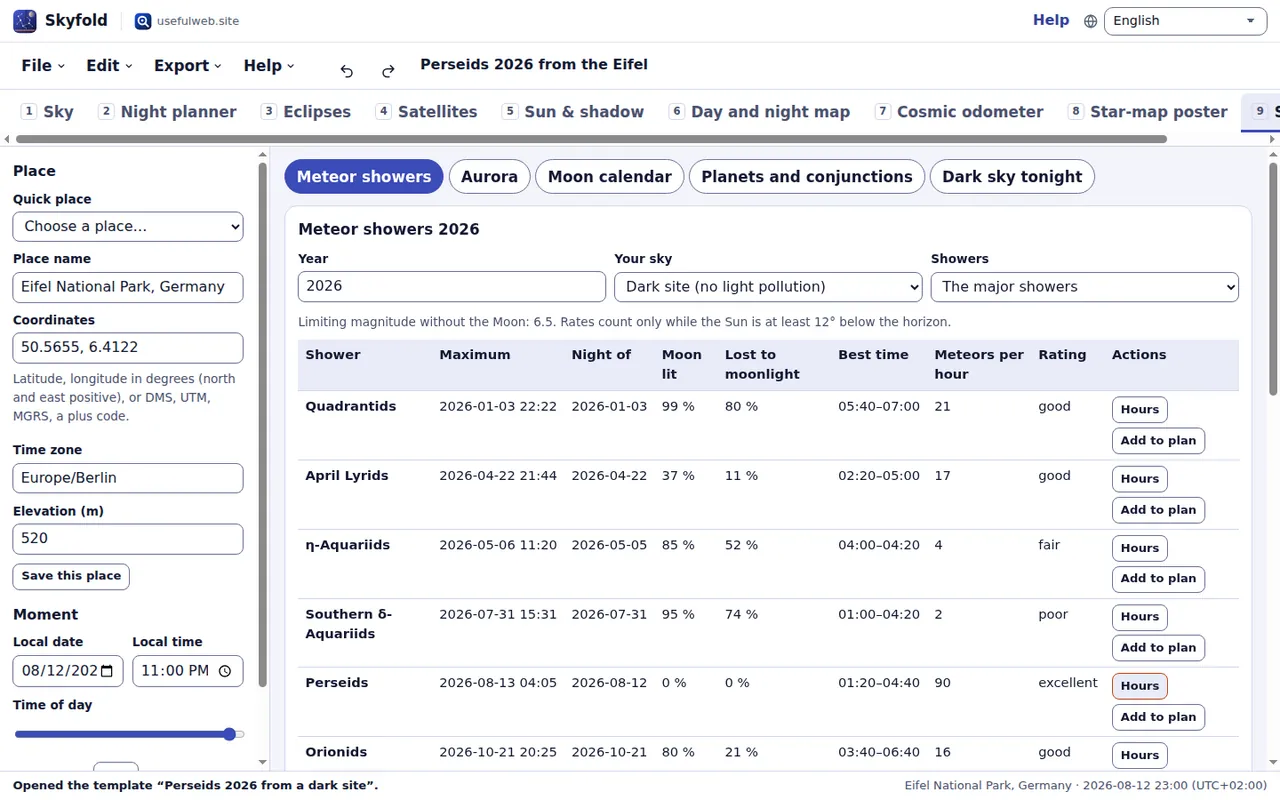
Pick your place and your sky
Set the place in the side panel as usual. The meteor list uses the year of the date in the side panel; change it with the Year field at the top of the list.
Choose Your sky honestly: Dark site, Rural sky, Suburban sky or City sky. Light pollution decides how many faint meteors you can see, so it changes every number below. The line under the fields shows the faintest stars you can see without the Moon (the limiting magnitude).
Showers switches between the major showers and every shower of the International Meteor Organization's working list.
Read the shower table
Each row is one shower:
- Maximum — the moment of the peak in your local time.
- Night of — the evening date of the night to go out. A peak at 04:00 belongs to the night that began the evening before.
- Moon lit and Lost to moonlight — how bright the Moon is and how many meteors it costs during the best hours. A bright Moon that has set does no harm.
- Best time and Meteors per hour — the hours with at least 70 % of the best rate and the rate you can expect then, already reduced for the height of the radiant, your sky and the Moon.
- Rating — from excellent to not visible.
Open the template Perseids 2026 from a dark site for a good start: the Perseids of 12/13 August 2026 come with a new Moon and reach about 90 meteors per hour before dawn.
Plan the night hour by hour
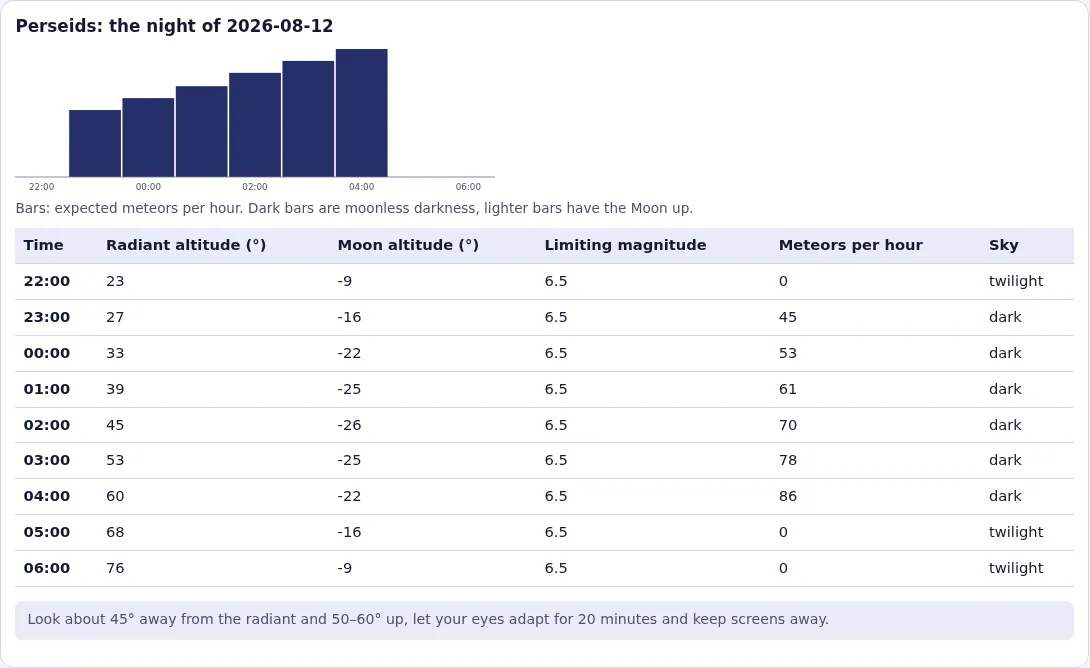
Press Hours in a row to show that night below the table. The bar chart shows the expected meteors per hour; dark bars are moonless darkness, lighter bars have the Moon up. The table beside it lists the radiant and Moon altitude, the limiting magnitude and whether the sky is twilight, moonlit or dark at each hour.
Add to plan puts the best window into your observation plan (see the Night planner tab). Download the best windows (.ics) exports all showers to your calendar with a reminder an hour before.
Is it dark enough?
Dark sky tonight looks at the night that starts on the date in the side panel. The headline tells you the longest stretch of moonless darkness, for example "Moonless darkness from 22:30 to 05:00 (6.5 h)". The timeline below colours the night in twilight, moonlit and dark, and the list shows sunset, astronomical dusk and dawn, sunrise and how much of the Moon is lit.
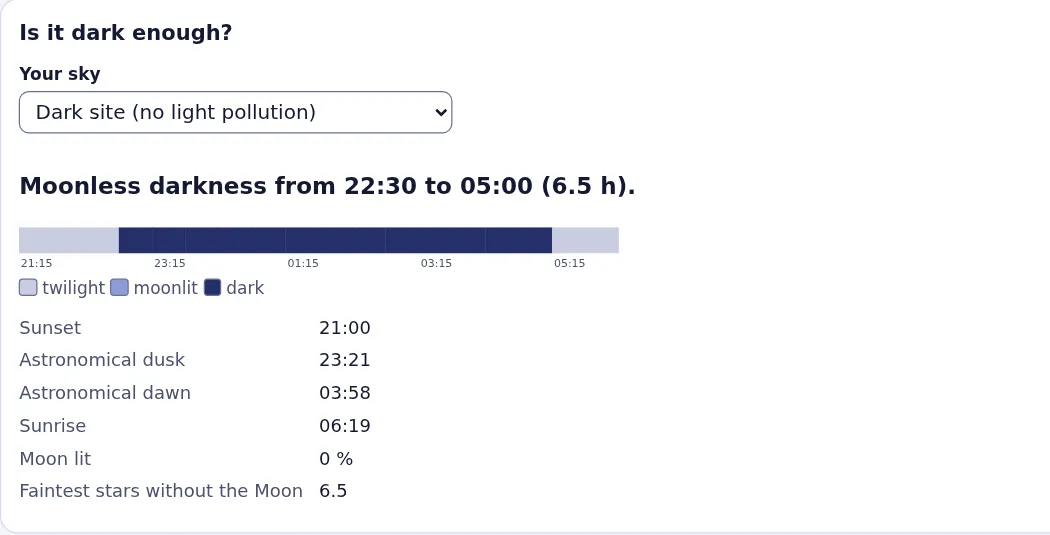
The table goes through the night every 30 minutes with the Sun and Moon altitude and the faintest stars you can see. Use it for any observing session, not only meteors: deep-sky photos, the Milky Way or a first look through a new telescope.
Clouds are not part of this tab; the Aurora tab, described in Aurora, Moon calendar and planets, adds the MET Norway cloud forecast for the next nights.
Ready to try it?